
National Institute of Health Carlos III (ISCIII)
About the ISCIII
Instituto de Salud Carlos III is the national reference in biomedical research and public health in Spain. It supports the development of knowledge in the health sciences and contributes to innovation in healthcare and disease prevention. It also provides scientific and technical guidance for the Spanish National Health system.
Named after King Charles III of Spain, ISCIII was founded in 1986 in Madrid where its two campuses are located today. The Institute reports to the Ministry of Science and Innovation and to the Ministry of Health and works in partnership with the other organizations that together form the Spanish system of science, technology and innovation. In 2019, with around 900 direct employees, the ISCIII managed a budget of €315M.
ISCIII’s GloPID-R representative is Elena Maria Doménech Cruz, International Programmes Coordinator.
our Work
Mission, vision and values
- Mission: To contribute to improving the health of all citizens and to fight disease through the promotion of research and innovation in health sciences and biomedicine by providing ground-breaking scientific and technical services and educational programmes to support the National Health System.
- Vision: In close coordination with other public authorities, to become the leading Spanish player on the world stage for public health and biomedical research.
- Values: social commitment, scientific integrity, public responsibility and teamwork and alliances.
ISCIII Activities
- Biomedical Research Funder & National Agency for Biomedical Research
- Scientific and technical public health services
- Specialized Health Training in Public Health and Occupational Medicine
Centres of excellence
The ISCIII has its headquarters on Campus Chamartín in Madrid and is responsible for Spain’s main public health laboratories. Its centres of excellence include:

The National Centre for Cardiovascular Research (CNIC) is a leading international research center dedicated to understanding the basis of cardiovascular health and disease and to translating this knowledge into improved patient care.

The CIEN Foundation was established to support, promote and coordinate research in all fields of basic, clinical and epidemiological neurology, with special emphasis on problems related to neurodegenerative diseases.

The goal of the Spanish National Cancer Research Center (CNIO) is to develop new and more effective approaches to preventing, diagnosing and treating cancer.
Organisation of research for greater impact
ISCIII Biomedical Research Institutes (BRI)
The ISCIII Biomedical Research Institutes (BRI) are research entities organised around hospitals and primary care centres within the Spanish National Health System (SNS), with the participation of universities, public and private research centres and companies. In these Research Institutes, multidisciplinary teams made up of researchers from various fields (clinical, academic, innovative, business) work together to develop knowledge that can be applied quickly to improve the health of the Spanish population.
Andalucia (4)
- IBIS,
- IMIBIC,
- IBIMA,
- ibs.Granada
Aragon (1)
- IIS Aragon
Balearics (1)
- IdISBa
Cantabria (1)
- IDIVAL
Castile and León (1)
- IBSAL
Catalonia (7)
- IDIBAPS,
- IDIBELL,
- IR-HUVH,
- IGTP,
- IIB Sant Pau,
- IMIM,
- IRB Lleida
Galicia (2)
- IDIS,
- INIBIC
Madrid (8)
- IDIPAZ,
- ISS-Princesa,
- IISFJD,
- IRYCIS,
- i+12,
- IiSGM,
- IdISSC,
- IDIPHIM
Murcia (1)
- IMIB
Navarre (1)
- IDISNA
Basque Country (2)
- IIS Biodonostia,
- IIS Biocruces
Valencia (3)
- IIS La Fe,
- INCLIVIA,
- ISABIAL
Update on ISCIII-funded COVID-19 research projects
-
Following the COVID-19 outbreak in February 2020, ISCIII launched two specific funding calls for epidemic research.
In the first call, 127 projects were funded for a total value of almost €30M.
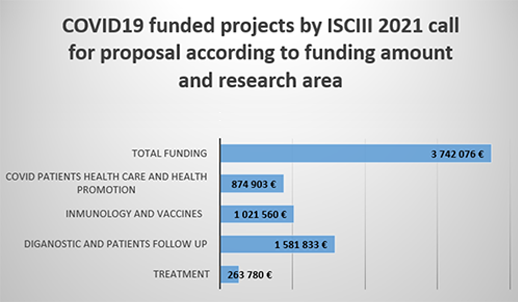
Source: ISCIII Web A second call was launched in March 2021, and a total of 38 projects were funded on the following themes:

Source: ISCIII Web Looking at these two graphs, we can observe a change in priorities within the scientific community in Spain, with patient follow-up and care emerging as a priority.
ISCIII on the international stage
-
Visibility in the global landscape and the internationalization of the Spanish Research & Innovation System are priorities for ISCIII. To achieve these objectives, it:
- participates in the definition and development of European and international research programmes
- contributes to the European Research Area
- maintains national and institutional representation in international research consortia as well as in European Research Infrastructures
ERA-NET co-funding
- HDHL Intimic
- Transcan III
- JPIAMR Action
- Neuron Cofund
- EU-CELAC Platform
Joint Programming Initiatives
- EJP-RD: European Joint Programme on Rare Diseases
- JPND 2
- HBM4EU: Human Biomonitoring to provide evidence for chemical Policy making
- JPIAMR
- JPIHDL: A Healthy Diet for a Healthy Life
Institutional Partnerships
- EU Africa for Global Health /EDCTPII
- AAL 2: Ageing Well in the Digital World
Partnerships outside the EU
The ISCIII is a member of the Ibero-American Health Ministries Network for Research for Health (RIMAIS) and devotes a great deal of time and resources to building and maintaining relations with partners in Latin America. RIMAIS is made up of 18 Ibero-American country members and aims to improve the coordination of health research and the implementation of health interventions.
More Information
Instituto de Salud Carlos III (ISCIII)
National Centre for Cardiovascular Research (CNIC)
Spanish National Cancer Research Center (CNIO)
Center for Biomedical Research Network Consortium (CIBER)
Networks for Cooperative Research in Health (RETICS)
Infrastructure for Precision Medicine associated with Science and Technology (IMPaCT) (in Spanish)